As part of the National Srebrenica Day of Remembrance, which is marked every year with the highest state honours throughout the UK, the charity, Remembering Srebrenica , founded in 2013, has again organised the largest commemoration of the 24th anniversary of the Srebrenica genocide this year. More than 1,100 events will be organised across the UK during Srebrenica Week of Remembrance.
More than 700 guests attended the UK National Srebrenica Commemoration at the Guildhall in London. The 2019 theme, “Bridging the Divide: Confronting Hate”, seeks to inspire people to stand up to those who seek to divide communities, celebrate those who build bridges between communities and change the attitudes and behaviours of others to go out and build their own bridges. This theme was chosen because it has never been more important for people to be empowered to confront hatred in their communities and to build bridges that help create a stronger, better and more cohesive society.
The program was hosted by Oliver Kamm , a widely known journalist. Oliver is a writer and columnist for The Times. He is also a long-time contributor to the Prospect, the Jewish Chronicle and other publications. He has written extensively on modern genocides and the dangers of denialism.
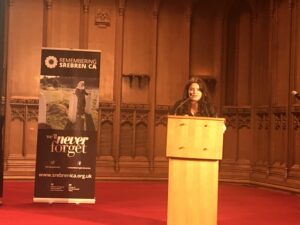
The opening speech was given by Mr. Waqar Azmi , Chairman of the organization “Remembering Srebrenica”. He emphasized that he was proud to work with people across the United Kingdom to pay tribute to the victims of the genocide: “Sadly, the victims of the genocide are still seeking justice after 24 years and trying to convey the message to the world that there is only one truth and that it must be told,” emphasized Dr. Azmi.
He also said that we must not forget the past, but that we must certainly move towards the future. And preserving peace and economic development of BiH are priorities for its future development, which can be achieved by ensuring political stability in the country.

The audience was addressed by various distinguished guests: Rt. Hon James Brokenshire MP , Secretary of State at the Department of Housing, Communities and Local Government, Lord Bourne of Aberystwyth , Parliamentary Under-Secretary of State at the Department of Housing, Communities and Local Government, and Ramiz Salkić , Vice President of Republika Srpska, who was taken from his post and imprisoned in concentration camps in Bratunac and Pale during the war. His two brothers and father were killed during that period. “We advocate for the adoption of a Resolution at the United Nations level to declare the denial of genocides recognized by the International Criminal Court or other UN courts illegal,” said Mr Salkić.
Survivors of the genocide, Sudbin Music, Fadila Efendić and Ramiza Gurdić, also spoke at the commemoration.

Sudbin Music He was only 18 years old when the Bosnian Serb army arrived in his village near Prijedor and began killing. Sudbin is now campaigning, together with survivors from other concentration camps in Bosnia, to confront the past and create reconciliation between communities. “I will never forget my last class in school and the last words of my high school teacher when he said: See you next school year – whoever survives. The end of the school year was actually the beginning of the end for a community that is still trying to survive today. Shortly after school ended, the first incidents occurred – the destruction of neighboring villages, the order to hang a white sheet from our houses, and when we left our homes, we had to wear white armbands. It was the first time since World War II that a group, due to their ethnicity, would be physically marked again. For this reason, in solidarity with the victims of Prijedor, we wear a white armband with the Srebrenica flower,” said Music.

Fadila Efendić , a mother from Srebrenica, lost her husband and only son in the Srebrenica genocide. Her husband was buried in 2003, but his skull was found in another mass grave two years later. As for her son Fejz, only two of his bones were found. Despite the pain and trauma of her horrific experiences, Fadila returned to Srebrenica to rebuild her house, which had been destroyed by Serbian forces; all that remained was her son’s diploma.
She uses her pain as a driving force to seek justice, not only for herself, but for all victims of genocide.

Ramiza Gurdić spent most of the war without electricity, water and food. She lost her husband, two; son and 38 family members who were all killed in the genocide in Srebrenica. Nothing can prepare you for some of the things Ramiza witnessed during the war or the trauma that comes from having loved ones taken away in such a barbaric way. The last time she saw her wife and sons was when they were walking through the forest towards the freedom they were hoping for. A mother’s love did not allow her to accept the fact that this view of her sons was the last.
Ramiza remained strong for her daughter and worked hard to rebuild their lives. She is a member of the Association of Mothers of Srebrenica and Žep Enclaves, where she fought for years for the truth and spoke publicly about the genocide in the hope of ensuring that such crimes would never happen again.
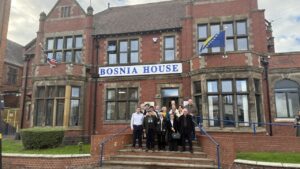
The audience also had the opportunity to watch two videos: ‘Our Impact: Voices from Birmingham’ and the 2019 Memorial Film ‘Bridging the Divide: Confronting Hate’. As part of this, the work of the Bosnia UK Network and the importance of the Bosnian House in Birmingham were mentioned, emphasizing that it is a successful umbrella organization that has been helping Bosnians and Herzegovinians in the UK for years.
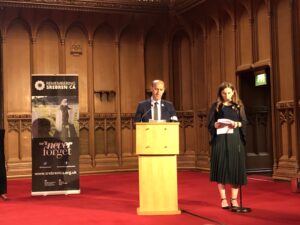
Amina Mekić , a young girl whose parents experienced the horrors of the genocide in Bosnia and Herzegovina, recited the Srebrenica Prayer that will remain engraved in the Srebrenica Stone with a strong message: May what happened in Srebrenica never happen to anyone again, anywhere. “I see genocide everywhere I go, in my parents, in my mother watching the fireworks, in my father through the stories he shares with the younger generations, in the Bosnian community in the UK and Bosnia and Herzegovina. There should not be a family in the world that will talk about survival and genocide at the dining table. But, despite everything, I see HOPE, through the education of new generations who will learn what happened and not repeat such atrocities,” added Amina.
The musical part of the program featured the excellent artists of the National Theatre of Sarajevo , Elvir Solak (guitar) and Aida Čorbadžić (soprano), who showed true professionalism and caused a storm of tears and emotions. Their performance certainly enriched this extraordinary event.
In memory of the victims, candles were lit. On that occasion, all those present paid their respects to those who are no longer there, to those left behind only in tears and mourning. 
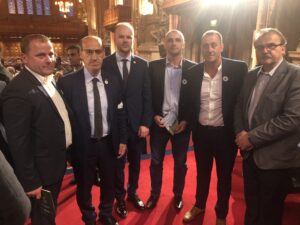
Delegates from the Bosnia UK Network and other Bosnian-Herzegovinian associations across the UK paid tribute to the victims of the Srebrenica genocide by attending, thus supporting the commemoration of the 24th anniversary of the Srebrenica genocide. Also, many Bosnians and Herzegovinians, despite the limited number of invitations, had the opportunity to attend the commemoration in London.
The lesson for all of us is that if hatred, intolerance and aggression are not prevented, violence in various forms will soon appear. We must be vigilant at all times. We owe that to the victims and their families.
Bosnia UK Network