Derviš Hadžimuhamedović is an archaeologist from Sarajevo and a student at University College London (Great Britain), which is officially ranked as the third best institute for archaeology in the world, with professors who are leading authorities, known to the entire archaeological community. Along with his work in the field of archaeology, his interest has expanded to heritage protection, and since 2015 he has been working as the coordinator of the International Summer School “Youth and Heritage in Stolac”.
He attributes his love for archeology to growing up in Bosnia and Herzegovina, an environment where Bosnian cultural heritage, its values and the dangers to which it is exposed are included in everyday conversations and activities in his life. He points out that he could not have chosen anything better as his vocation, and that he intends to do archeology for the rest of his life and contribute to the improvement of knowledge about archeology in Bosnia and Herzegovina.
– My mother, in a now generally accepted and then unusual way, combined her parental duties with her work, which she did with great responsibility and passion. In her office, the walls of which were filled with photos of Bosnian heritage, my sister and I wrote our homework and had fun reading and drawing about Bosnian cultural heritage. We spent free school days and vacations following her projects at archaeological sites, historical monuments, exhibitions, conferences. We had fun. We had a wonderful childhood, filled with beauty and imagining magical past worlds, but also with many privileges to enter places that only explorers can enter, such as the Villa dei papiri in Herculaneum or the top of the Hagia Sophia dome under construction. “Probably, before I learned basic calculations, I knew how to distinguish between Doric, Ionic and Corinthian style orders,” says Hadžimuhamedović.
What opportunities did you have in Bosnia as a young archaeologist?
– While I was studying, I was lucky that my professors from the University of Sarajevo secured a wonderful project of international cooperation with the aim of improving the archeology curriculum, in which, apart from professors Adnan Bususladžić, Adnan Kaljanac, Amra Šačić-Beć, Selmedin Mesihović, we learned from professors from Cambridge, Berlin, Slovenia, Serbia, Croatia and, as students, accompanied these professors on field research. I felt the excitement of archaeologists for the first time when I found a flint arrowhead from the Late Bronze Age during the research of the Zaketuša site near Srebrenik. It was then that I participated for the first time in the application of non-invasive archaeological methods, which were significant for illuminating dilemmas about the existence and extent of the archaeological site. I must say that I belong to the lucky generation of archeology students, who could not have their undergraduate education at a higher level, probably not even at some much older and more famous studies.
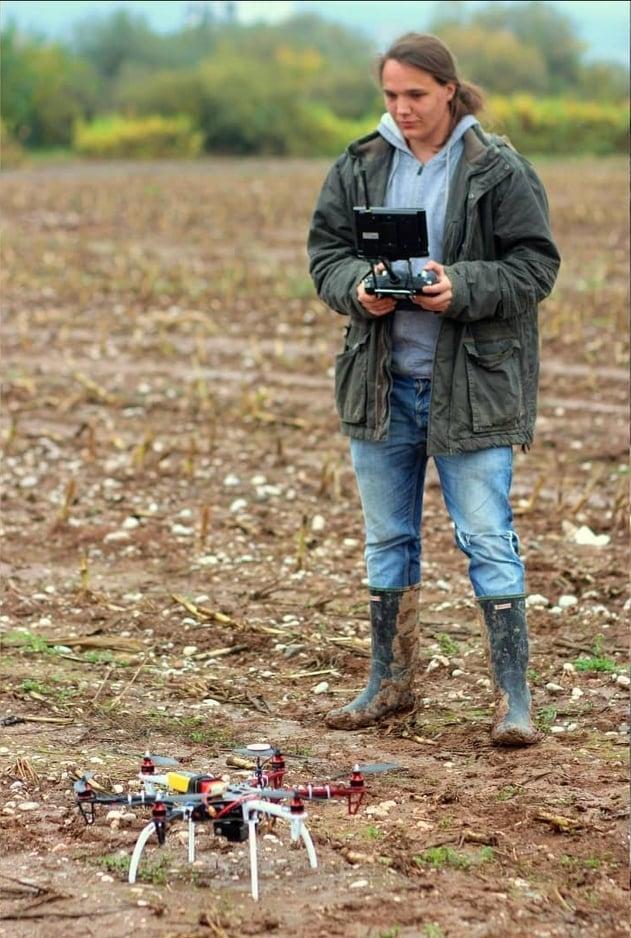
I consider the establishment of the Institute of Archaeology at the Faculty of Philosophy to be important. The obligation of systematic and protective archaeological research should be legally and institutionally included in the development plans of Bosnia and Herzegovina, to prevent illegal construction on unexplored or already known archaeological sites, as well as illegal excavations incited by the black market. That is why it is important that the Institute be strengthened and that the official authorities provide it with all kinds of support. Professor Adnan Kaljanac and his team from the Institute included me, as a volunteer, in several projects they worked on. In this way, I had the opportunity to participate in the application of non-invasive methods in archaeological research, such as remote aerial drone imaging, magnetometry, ground-penetrating radar imaging, electrical resistivity imaging, etc., which are the subjects of my specialist focus. The application of non-invasive methods can significantly contribute to reducing the costs and shortening the time of archaeological research, as well as to the protection of archaeological finds.
What is it that drives you?
– In the business I intend to engage in, the greatest driving force for me is the splendor and layering of Bosnia and Herzegovina’s heritage, its insufficient research and the worrisome state it is in due to legal and institutional disorder, the lack of an appropriate strategy for including archaeological research and the protection of cultural heritage in sustainable development plans. The policies of destruction of the integrity of Bosnia and Herzegovina begin with the neglect, fragmentation and misinterpretation and use of its heritage. This is what admonishes and inspires me, and in which I find the responsibility to, together with my colleagues and friends, wherever I am, contribute to the improvement of knowledge about this country and the situation in it. I hope to be able to do that here, in strong institutions and with motivated experts. If that is not possible, wherever I am, the heritage of Bosnia and Herzegovina will be a priority interest and the subject of my work .
In 2019, when I continued my studies at the prestigious Institute of Archeology at University College London, one of the best-ranked studies of its kind in the world, in laboratories and in libraries that provide the greatest research comfort, I did not stop to think how my professors from Sarajevo manage, in conditions that are incomparable to those offered by large world centers, to impart knowledge that is not negligible. I went to London thanks to the Chevening scholarship that I received after I was accepted to study the application of geoinformation systems in archaeology, data processing and research into the complexity of archaeological landscapes through the recognition of certain patterns, which are important for contemporary research. It is an approach that has not been applied in our country, and my knowledge gained from it can significantly strengthen the efforts of a team of experts who strive to improve archeology in Bosnia and Herzegovina.
 How do the English perceive Bosnia and Herzegovina?
– Scientists and professionals in the field of archaeology at my university in London perceive our country as one of the most significant and potent European areas for archaeological research, as one of the least explored areas, and as one of the areas where the level of threat to archaeological sites is at its highest, and the capacities – legal, institutional, human resources, and even political will for their improvement – are at their lowest. My professor Andrew Bevan was delighted with the opportunity to demonstrate through my final project the potential that modern methods offer in the research of Bosnian heritage, its protection, and its inclusion in the body of global knowledge about the world, where there is currently a large gap.
Tell us something about the International Summer School “Youth and Heritage in Stolac”? Are you planning any new projects in the future?
– The rich cultural and historical heritage of this small town was systematically destroyed during the war. In parallel with the process of returning refugees, the reconstruction of destroyed buildings began. The most important project of education about the values of this heritage for the reconstruction process was launched in 2006. Through 15 schools so far, 500 young people from all parts of Bosnia and Herzegovina and the rest of the world have gone through educational and practical workshops. We worked on the reconstruction of Stolac mosques, watermills, clock towers, neglected cemeteries, but also small vernacular buildings. These small buildings, called HIDR – Houses of International Dialogue and Research, are today the bases of our School. Through workshops of traditional crafts and knowledge, educational workshops of experts from the world’s best universities, but also work with the local community, young people have the opportunity to learn firsthand about the value of heritage, both tangible and intangible, and the importance of its preservation. The School is held every year in July and August.
The project, with its results so far, has transcended the boundaries of Bosnian and Herzegovina’s interests. Our network consists of about 700 young people from about 40 countries around the world. This year we had an online School and a recapitulation of the results so far, considering that we have marked 15 years of work. We are currently working on an activity plan for the next 10 years and it is aligned with the UN Sustainable Development Goals – Agenda 2030. We will formalize the School’s alumni network and include some of them in the Program Council. This is great potential. Part of our program goals is to more intensively include people originally from Bosnia and Herzegovina in the work of the School, either as participants or as lecturers.
What is your opinion about the education system in Bosnia and Herzegovina?
– Here I must separate my personal experience, which was very good, given a whole range of circumstances, from the general knowledge about our education system. That system reflects the still ongoing effort to destroy Bosnian and Herzegovinan society, its luxurious diversity and the strength that stems from it. There are numerous brilliant individuals working in education, but the system is very weak, and political greed is reflected in it. I do not see any effort to improve spatial and educational capacities; professors are unmotivated – from salaries, to working conditions, to incentives for research; there is no clearly established connection between education and science, nor the necessary public incentive for science; there is no healthy competitive spirit among teachers in projects and publications; work with students is not subject to constant improvement of methods and examination of achieved results; the student parliament is completely in the clutches of the most retrograde political manipulators… In addition, numerous claims about plagiarism, nepotism, corruption remain speculations that no one deals with. These are such serious allegations of dangers that could have long-term consequences in all segments of Bosnian and Herzegovina society that they deserve urgent examination and, either the rejection of the allegations as unfounded, or the prosecution of those involved in these processes if the allegations prove to be justified. There is no more important issue for the future of this society than solving the problems in education. Saving the education system and pulling it out of the abyss in which it is now is the safest and most necessary path to saving this society.
INTERVIEWER: LAMIA SELIMOVIĆ
My freedom.oslobodjenje.ba