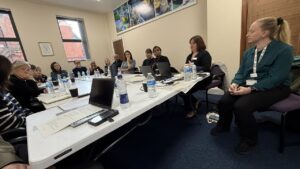
The first online session organized by the Alumni of the First Bosniak Gymnasium was held on the topic “What kind of education do we need?”
We need education based on vital knowledge and values
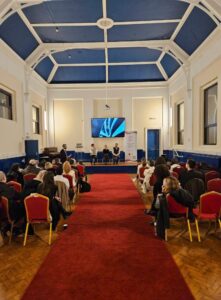
On Wednesday, December 9, 2020, the Association “Alumni of the First Bosnian Gymnasium” held an online panel entitled “What kind of education do we need?” , the first within the project of online sessions for our future #Bosnae2050?, in which topics important for reflecting on the future of Bosnia and Herzegovina will be continuously discussed.
Almasa Odžak, associate professor at the Department of Mathematics at the Faculty of Science, University of Sarajevo, emphasizes that we must be aware that acquiring knowledge in itself, without worrying about how it will be applied, can be very dangerous.
“We need functional knowledge directed in the right way for the purpose of good.” , said Odžak, adding that reproductive knowledge is at the bottom of the knowledge scale and the importance of such knowledge is significantly decreasing with the development of modern technologies and the fact that information can be accessed in a short time.
“Scientific collaborations can significantly accelerate the process of developing scientific and research infrastructure in BiH,” says Adnan Mehonić, PhD in Electronics and Electrical Engineering, Assistant Professor in the field of Nanoelectronics at University College London. Dr. Mehonić believes that more work is needed to connect the scientific BiH diaspora with the domestic academic community in Bosnia and Herzegovina.
Amila Pilav-Velić, PhD in Economics, Associate Professor at the Faculty of Economics, University of Sarajevo, reflected on the current situation, saying: “Today, when the world is facing one of the biggest crises in recent history, we have seen that investing in science and research has proven its full justification. Despite all economic and political measures, the discovery of a vaccine shows that science and innovation will still play a crucial role in overcoming this crisis, but also in the recovery of the healthcare system, economy and society as a whole.”
Dr. Pilav-Velić believes that in this global scientific race, Bosnia and Herzegovina, first and foremost, needs to work on developing and strengthening its scientific research infrastructure, and creating an educational policy with clear strategic goals and concrete measures that will lead it towards the educational system we need – functional, innovative, practice-oriented and flexible.
“Improving education begins with improving the quality of teacher education, curricula, and the teaching work itself in the classroom. I believe that as a first step, we need to change the orientation in curriculum planning – at all levels. This would mean that instead of subject content, we start with vital knowledge and values that young people need to adopt,” said Amina Isanović Hadžiomerović, Department of Pedagogy, Faculty of Philosophy, University of Sarajevo (UNSA).
The focus of improvement must also be on primary education, because that is where elementary knowledge and the basic apparatus for further learning and the use of knowledge in a functional sense are acquired.
“Everything that happens in society has its reflection in the classroom. The values that society lives by are also present in the classroom. Therefore, every educational reform must include a broader social reform. We need quality education, which will encourage all participants to excel, lead and cooperate,” said Naida Hota-Muminović, director of the First Bosniak Gymnasium in Sarajevo, at the panel, adding: “Schools as places of learning, places of meeting and ideas, must become competitive and attractive, and they can only do that if we focus on the process itself.”
“Much of this could be attributed to phenomena characteristic of transitional, but also post-conflict and divided societies such as BiH. Divided competence in the field of education by entities, in the Federation of BiH further decentralized by cantons, already hints at fragmentation, or the coexistence of multiple educational programs and systems within BiH. The phenomenon of ‘two schools under one roof’ is only part of our distorted reality,” Mirza Emirhafizović, Doctor of Sociology, Associate Professor at the Faculty of Political Science, UNSA, underlined during the panel, and concluded: “As a community, we have not reached a consensus or agreement on what we are striving for – a Society of Knowledge or Anti-Knowledge,” Emirhafizović concluded.
It is important what perception of the value of education prevails in society, in other words how much educational achievement, acquired knowledge, abilities and skills of individuals are valued, and not just a formal diploma. In addition to favoring the functional acquisition of knowledge as opposed to reproductive learning, the education process should not neglect the cultivation of moral values and humanity, including empathy, altruism, solidarity, and the culture of dialogue.