Social gatherings of more than six people in England will be illegal from Monday – with some exceptions – amid a sharp rise in coronavirus cases.
The changes to the law will ban large groups from gathering anywhere socially indoors or outdoors, the government said.
But this will not apply to schools, workplaces or weddings, funerals and organised team sports subject to Covid safety measures.
Those who fail to comply with the new measures will be fined £100, doubling each offence to a maximum of £3,200.
The new rules – which come into effect on September 14 – mark a change to the current English guidelines.
Currently, the guidelines say that two households of any size can meet indoors or outdoors, or up to six people from different households outdoors. Until now, the police did not have the power to stop gatherings if they did not exceed 30 people.
Prime Minister Boris Johnson is expected to give more details about the changes at a Downing Street press conference later on Wednesday.
“One of the feedbacks we got, including from the police, was that we needed to make the rules super simple, so that everyone knows and understands,” said Health Secretary Matt Hancock.
“And now the police will strictly enforce this.”
Mr Hancock told BBC Breakfast: “This is really simple. Gatherings are OK, of course, they should be socially distanced, but groups of up to six.”
He said this means some families will not be able to see both grandparents at the same time. “You know, I have three kids,” he said. “We have a family of five. So we will be able to see one person at a time, like a whole family.”
Challenged whether the new rules could stop grandparents helping with childcare, Mr Hancock said: “I’m not actively trying to do that”.
But he said the government was “quite concerned” about the “very serious problem” of children potentially passing the virus on to elderly grandparents.
Mr Hancock was also asked about testing, after people with symptoms struggled to get tested in recent days.
“Unfortunately, we’ve seen this pretty sharp increase in people without symptoms who don’t have a good reason to come forward and get tested over the last few weeks,” he said, adding that 25% of people who have taken a coronavirus test are ineligible.
“We’ve even heard stories of people saying, ‘I’m going on vacation next week, so I’m going to take the test.’ No. There’s no need for a testing system for that.”
There are exceptions to the new rules. Households and support bubbles of more than six can socialize together – but not with anyone else at the same time – and gatherings can be more than six if it’s for work or education purposes.
Number 10 said any group of seven or more people congregating anywhere “risks being dispersed or fined by the police for disobeying the law”.
BBC political correspondent Nick Eardley stressed that pubs and restaurants could have more than six customers, but that groups of six would have to be socially distanced from each other.
The rationale for allowing this, but not larger groups of people inside other people’s homes, is that businesses can only be open if they follow the safety and hygiene measures set by the government, he added.
Downing Street said Mr Johnson held a virtual roundtable with police forces last week and heard that officers wanted clearer rules and enforcement of social distancing laws.
The number of people allowed to meet indoors or outdoors varies across the four UK countries. If you are meeting indoors: up to eight people from three different households can meet in Scotland; up to six people from two households in Northern Ireland; up to four households can form an “extended household” in Wales.
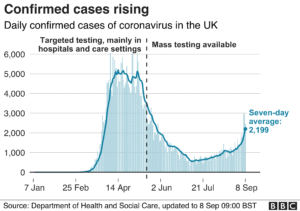
Ministers and government advisers have previously expressed concern about the “sudden increase” in cases, and a “sincere” apology has been issued for the shortcomings of the English testing system.
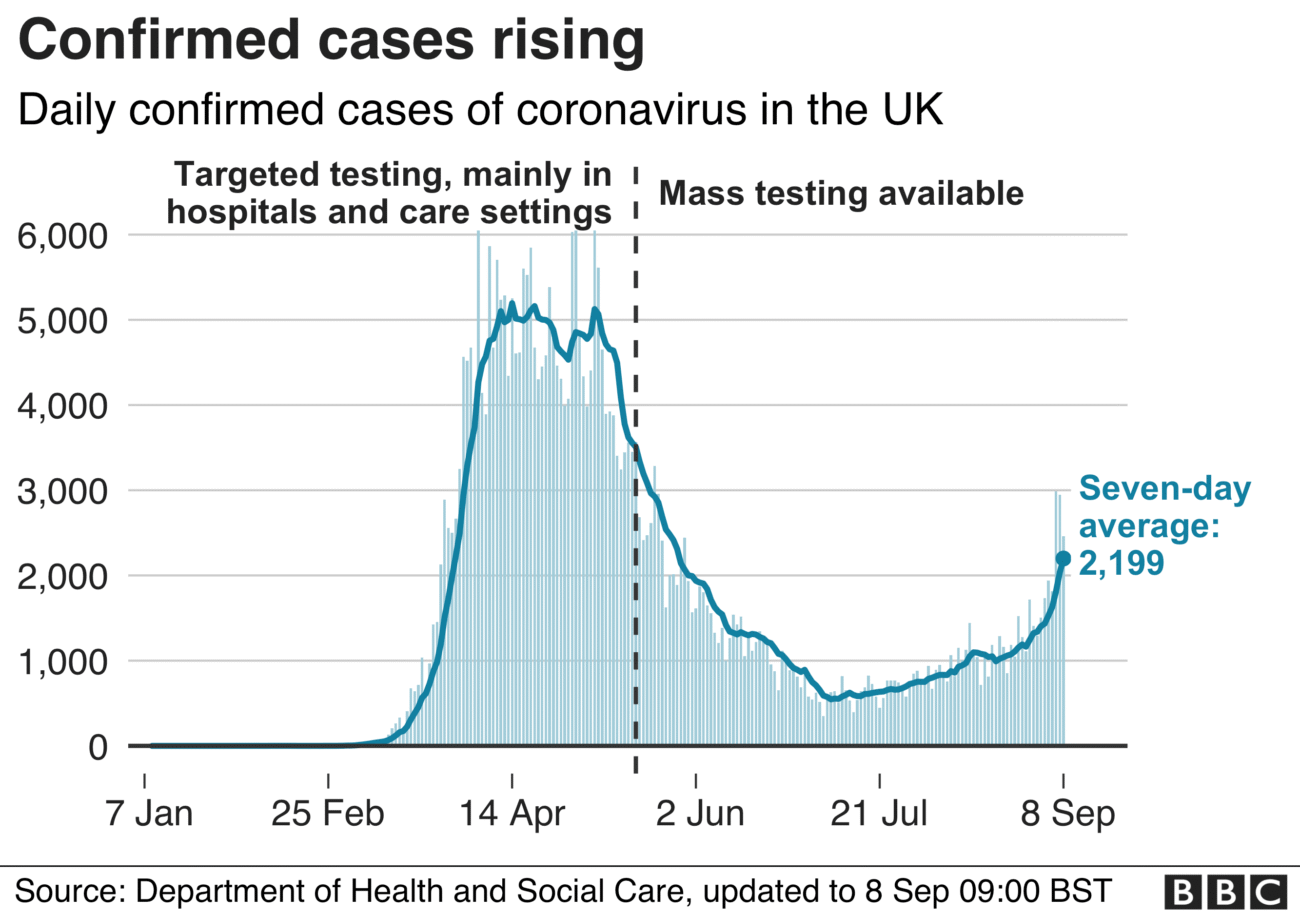
A total of 8,396 new cases were recorded since Sunday, and 2,460 on Tuesday alone.
32 deaths have also been reported, but they are not believed to be linked to the latest surge in cases.
The rise in cases seen in recent days has caused alarm among ministers and their health advisers.
They believe the UK is at a critical point ahead of the start of autumn and winter, when respiratory viruses tend to thrive.
Close contact within homes remains the most common transmission risk identified by contact tracers.
It is clear that people living with an infected person are most at risk.
But after that, the most common contact of infected individuals is with visitors to their household, according to data collected by England’s NHS Testing and Monitoring Service.
Ahead are entertainment venues, shops, workplaces and healthcare facilities.
Obviously, large gatherings in homes – especially indoors, which is more likely to happen when the weather changes – pose the greatest risk.
Ministers will also make it clear that further restrictions will follow if the growth of infections is not stopped.
Taken and translated from the BBC news site