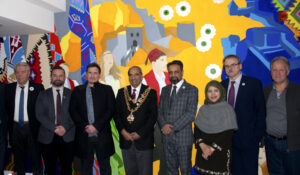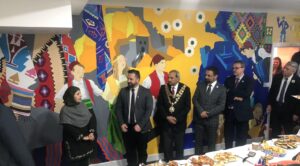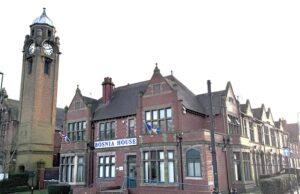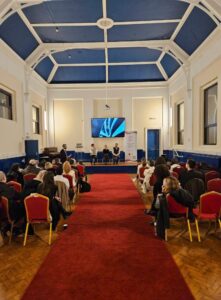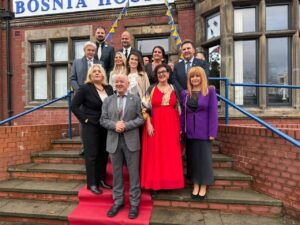

A mural was unveiled in the premises of the Bosnian House, as a result of the collaboration between Bosnia UK Network and Celebrating Sanctuary. It was officially unveiled by: Mayor of Birmingham Mohammed Azim, Dr. Azmi Waqar OBE, His Excellency Vanja FIlipović and President of BH UK Network, Zaim Pašić.
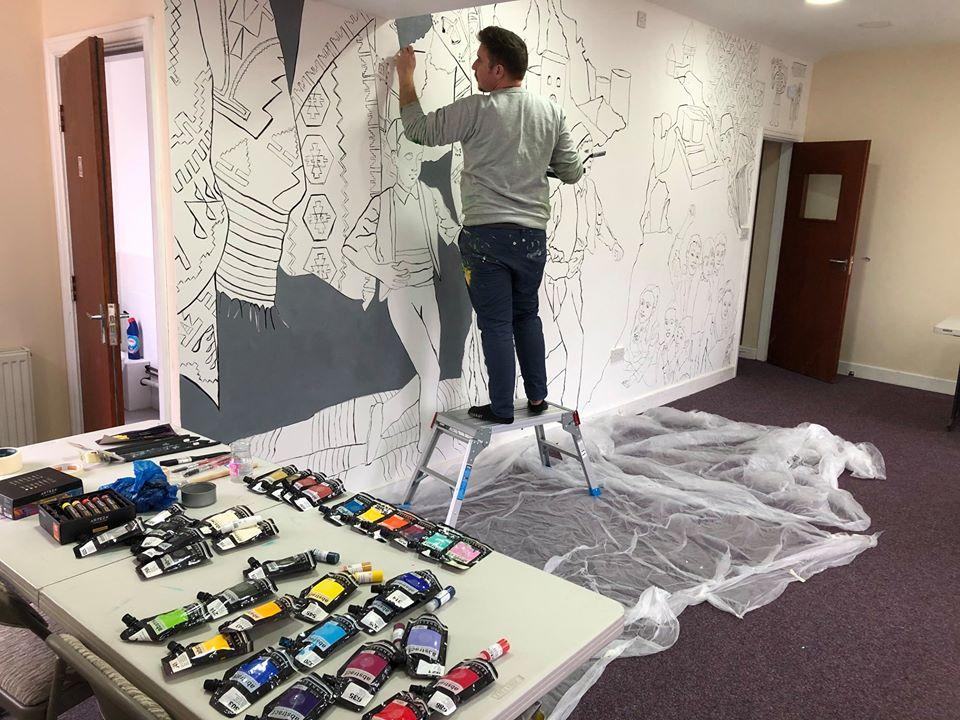
The mural was painted by the outstanding artist David Thomas Barry with the help of Birmingham artist Shaheen Ahmed, who got the idea and inspiration for the mural after a workshop with the students of the BiH secondary school in Birmingham. Together they came up with a plan, and David managed to bring it to life with his talent. The width of the mural is 6 m, and the height is 3 m.

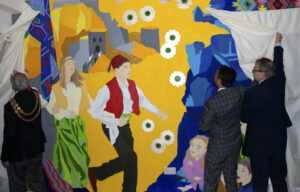
Attached is a text from David, who explains his inspiration for the Mural:
The mural is a celebration of the Bosnian identity and is intended to enrich the space with its wealth of colors, the sounds of dance, song and laughter that I experienced in the Bosnian house.
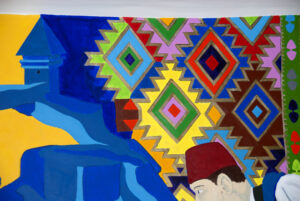 I started with the pattern and looking at pictures of Sarajevo carpets and carpet shops. The distinctive color schemes of fabrics (especially reds, oranges and greens) triggered my urge for color in me as a mechanism to enrich, decorate and convey joy.
Dancers and accordionists are also a link to the Ottoman influence in Bosnia, but they also remind us that identity is protected and nurtured by the passing down of traditions, such as the Kolo dance, from generation to generation. The Bosnian House is the space in which this happens.
Children observe and learn and it is they who are painted on the mural because children are the future – of Bosnia and Herzegovina and Great Britain.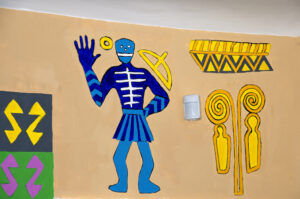
Two castles, Srebrenik Kula and Old Castle Ključ, are the background of the mural. The castle in yellow, near the town of Srebrenik, was the hometown of the first Bosnian king, Tvrtko I Kotromanić. The castle, painted blue, ended the era of the medieval Bosnian state with the surrender of King Stjepan Tomašević.
Above the door are paintings from the Stećak (monumental medieval tombstones associated with the Bogumila sect) that are scattered throughout Bosnia and Herzegovina. The man waving above the door reminds us that everyone who enters Bosanska House will be welcome. 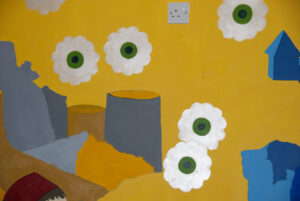
The castles were painted in the colors of the Bosnian flag, and the stars of the flag were replaced by the Srebrenica flower – a symbol of the memory of the genocide in Srebrenica. Over five days in July 1995, more than 8,000 Bosnian Muslim men and boys were killed by Serb forces and buried in mass graves. The white petal represents the innocence of the victims, and the green center represents the hope for justice. I drew the flowers as if they were blowing in the wind, like a behar.
Mural in Bosnia House – Speech by David Thomas Barry