Smajo Bešo, a Geordie refugee and survivor of the genocide in Bosnia, is justtorn away at the age of 9from their homeland, after a merciless period of starvation and barbarity.
Despite having lived through such atrocities, he shared his story. For him, there is power in humanizing history and breathing life into the dull statistics of war.
“The Bosnian genocide is often reduced to a single event in 1995, the Srebrenica massacre, where more than 8,000 Bosniak Muslim men and boys were killed,” said Newcastle University lecturer Smajo, 36, who now lives in High Heaton.
“But you have to keep in mind that during the aggression against Bosnia and Herzegovina, 100,000 people were killed, countless women and girls were raped, and more than 2 million people were displaced.”
“Genocide really removes you from everything you know and everything you love.”
When the war started in 1992, Smaj’s family had just settled in a “nice new home” in the town of Stolac and bought a dog for the children to grow up with.
“Everything was great, we lived in an advanced and modern society,” said Smajo. But it will soon become the center of Europe’s biggest crime since the Holocaust.
Cruelty did not come all at once, but there was a “drip-feed” of terror that began to “infect” everyday life.
“As I get older, I realize how hard my parents tried to protect us children and how difficult it was,” Smajo said. “My earliest memory of things not being right was when I ran into my house one day to find my mom crying in front of the TV.
“She told me everything was fine, but then she hugged me so tightly. It wasn’t until years later that she told me she was watching a report on the conflict that was spreading across the country.
“She knew we wouldn’t be safe for long and she was completely helpless.”
He recalls that soon after that, his mother Šefika locked their front door for the last time: “We didn’t know, but in those first 9 months of the war, we would move 14 times.”
Smaja’s father Džemal joined the local army, rallying against the occupying Serbian army with his Croatian friends and neighbors.
However, a year after the war, the Bosnian Croats began arresting members of their own infantry who happened to be Bosniak Muslims.
His father was taken to the Dretelj concentration camp and was eventually deported from Bosnia to the United Kingdom in January 1994.
Meanwhile, Smajo and the rest of his family stayed and lived with his uncle.
He remembers how in August 1993 soldiers came to the area and threatened “to kill us and rape the women”.
“The adults were searched, and then we were rounded up like cattle and forced to march to a new location.
“I remember seeing so many things thrown by the side of the road and at one point I ran over what I thought at first was a pile of clothes.
“It was heavy underneath, and I realized it was the corpse of an old man. He was dressed in the same suit my grandfather wore.”
After the arduous journey, his family settled in the city of East Mostar, where they lived with Smaja’s aunt, her children and his grandfather and grandmother.
“Even though we were far from the front, the area was surrounded and bombed daily by Croats and Serbs.
“We lived in such inhumane conditions – we were starving, forced to eat grass and chicken feed to survive.
“The winter was incredibly harsh – we had no firewood and we didn’t see anything from the international community.”
In fear, there were large stretches of boredom where children had to come up with creative ways to entertain themselves without toys or games.
“We were eager to go to school, to feel those bits of normality again,” he explained.
“Classes would be held at night and we would have to risk explosions to attend.
“Spending time with other kids and getting a piece of our childhood back was an act of resistance.”
One school night will forever be etched in Smaj’s memory.
In January 1994, planes dropped explosives on the city and “the whole building started shaking like never before.”
He said: “Everyone was screaming. But I was so paralyzed with fear that I couldn’t even cry.
“I could see our street from the school and it was under attack – I was afraid that everyone I love would be taken away or killed.”
His fear was not unfounded because in the house his aunt Emina was wounded in the stomach.
She recalls how the family struggled to get her to the hospital, but that because of the sanctions, “gasoline was like gold dust,” so they had to transfer her from one car to another.
By the time she arrived at the city’s makeshift medical facility, she had lost a lot of blood and they had no medication to ease her pain.
Smaja’s aunt who was killed in the attack
“The doctor who treated her was her cousin,” explained Smajo. “The family did everything, everyone tried to donate blood, but she passed away in the early hours.
“Losing such an incredible character was a defining moment in the war. She was always smiling, reaching out and giving us a clear vision for the future – and then suddenly she was gone.”
“In that moment I was filled with so much anger. A part of me was torn away and all hope was lost.”
But instead of letting him succumb to that hatred, Smaj’s mother did something incredible.
Recognizing that there was a possibility that her children would become perverted because of the anger they felt toward the invading forces and Christians as a whole, she dug deep.
“She somehow found the strength to sit down with us and carefully explain that there are always good and bad people in every group and that you should never generalize,” Smajo said.
“She taught us that in moments of devastation, you don’t survive by giving up your morals, but by holding on to them even tighter.”
Following a family tragedy, Smajo and his immediate family spent a month in a Croatian refugee camp before being transferred to the UK as part of a government plan in July 1994.
July 1994 after arriving in Newcastle – Smajo with his brother Sead, sister Senad, mother Šefika and father Džemal
He still has copies of letters from Newcastle MP, Labor politician Jim Cousins, to the Croatian and Bosnian governments demanding the safety of the family and describing them as his ‘constituents’ before their arrival.
Smajo said: “Imagine, we lived in East Mostar, dehumanized and surrounded by Serbian and Croatian armies.
“But in the UK, people went out of their way to locate us and help. It was the greatest recognition.”
Arriving in Newcastle, the family was housed at Gosforth Refugee Centre.
Smajo remembers how an elderly couple living in the neighborhood welcomed them all to their house and threw parties to celebrate their arrival.
However, the “honeymoon period” was short-lived. When Smajo started attending Chillingham Road Primary School, he struggled with PTSD, could not speak English and “kept dreaming of going home”.
At the end of each day, his teacher would have the class sing the same song before going home.
“I couldn’t understand what those words meant,” he said. “And every day it would frustrate me more because I felt like an outsider.”
But one afternoon, to his amazement, he could “miraculously understand what was being sung.”
Smile with Emily and Claire / Skimstone Arts staff
“I was in such shock,” he said. “My teacher taught the children to sing in Bosnian, so I felt included.”
“It was such a significant moment for me because during the genocide, Bosniak Muslims were treated with such contempt.
“But here I was recognized by a group of people. And that spirit of support is what makes the North East so special.
“Newcastle is a sanctuary city, it’s my home, and I’m incredibly proud of it. My family is a testament to the kindness of the people here.
“I know it may not be mathematically possible, but I see myself as 100% Geordie and 100% Bosnian.”
Years later, Smajo will be re-introduced to that very teacher in a chance encounter.
After she stopped teaching, Claire Webster Saaremets founded Skimstone Arts: an artist-led organization that supports diverse artists, people, and communities at risk of isolation.
Smajo recognized her immediately, and from then on they had a strong influence on each other’s lives – working together to pass on Smajo’s experience.
Looking back, Claire said: “When I was teaching, we weren’t told anything about what these kids went through.
“But what I saw was a lost little boy, with so much pain trapped inside him that he couldn’t even begin to communicate.
“I knew we would never be able to repair the loss of his landscape, his identity and his family. But we had to do something.”
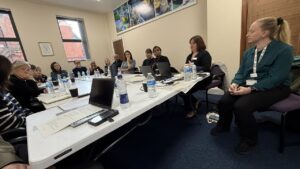
“It is a privilege to meet Smaj again and collaborate with him on projects like the One Day Changes the Holocaust Memorial Event, which invites storytellers to respond to the theme of genocide through various artistic media.”
“He could so easily not do the job he does, because of the trauma, but he does it because he wants to make a difference and teach others.
“Whether it’s art or journalism, we must continue to share these stories, humanize them and learn from them.”
As Claire testifies, Smajo works tirelessly to educate others about the genocide in Bosnia and its repercussions.
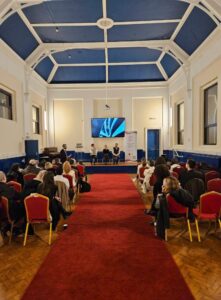
When he is not teaching architecture at Newcastle University, he dedicates a lot of his time to holding commemorative events and informing others about his refugee experience.
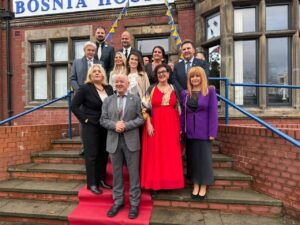
He worked with Newcastle City Council to recognize the genocide in Bosnia, and in 2018 he founded the Bosnian Genocide Education Foundation to help others learn from the crimes and remind people that “these terrible things can happen anywhere.”
Recently, the foundation collaborated with the organization Give Racism the Red Card to pilot a scheme in school, using his story to teach young people the beauty of compassion.
First introduced at Hadrian’s School in South Shields, the program will be rolled out nationally this year.
Translated from chroniclelive.co.uk
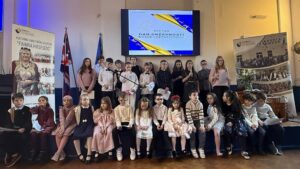
Smajo with students who participated in the “Making Peace” program