
UK National Srebrenica Memorial Day
A warm July night in London. People are walking happily on the streets of the city, enjoying the charms of summer, like everywhere else in the world. Tourists are trying to capture the architectural wonders of London with their cameras, especially the Guildhall and The Shard, a building with a huge number of floors and from the top of which there is an excellent view of this European metropolis.
Guildhall is so close to us, Bosnians and Herzegovinans. For several years, the walls of this beautiful building from the 15th century, a structure that captivates the eyes with its exterior and interior, have provided comfort. The Guildhall has a beautiful gallery and breathtaking paintings and sculptures.
Tonight, the Guildhall, as it has so many times before, offered solace to suffering souls, including me. And while I walk and organize my impressions, I still struggle with tears that have accumulated for more than twenty years, like many of us who survived the war in Bosnia and Herzegovina.
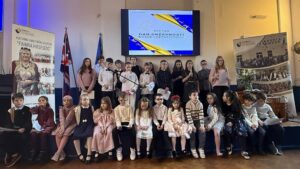
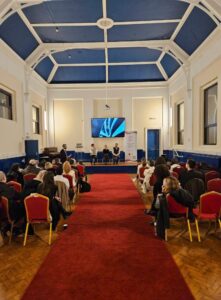
The UK National Srebrenica Memorial Day has just concluded at the Guildhall. National commemorations in the UK have been held in a row since 2014. For the sixth year in a row, we who live on this island country have had the opportunity to pay tribute to the victims of genocide in Srebrenica and throughout Bosnia and Herzegovina, and that makes me extremely proud.
With the help of the organization “ Remembering Srebrenica ” headed by Dr Waqar Azmi OBE and with the support of key figures from the British government, many victims have had the opportunity to tell their war stories to the world. And not only that. With the help of this humanitarian organization, 6,200 remembrance activities have been organized in the UK, and 211,000 people have been involved in the project that aims to raise awareness of the genocide, fight hatred, build bridges of friendship and bridge differences between ethnic groups. Over 90,000 young people have been educated about Srebrenica and the consequences of hatred, and 1,200 champions from different communities have participated in it. Many media will write about this event, and what I want to do is just convey my impressions and share them with readers on this saddest day.
And now that it’s all over, and after almost a quarter of a century, I wonder how it’s possible. Tonight we listened to stories about real life traumas that happened at the end of the 20th century in the heart of Europe.
Guildhall is so close to us, Bosnians and Herzegovinans. For several years, the walls of this beautiful building from the 15th century, a structure that captivates the eyes with its exterior and interior, have provided comfort. The Guildhall has a beautiful gallery and breathtaking paintings and sculptures.

Tonight, the Guildhall, as it has so many times before, offered solace to suffering souls, including me. And while I walk and organize my impressions, I still struggle with tears that have accumulated for more than twenty years, like many of us who survived the war in Bosnia and Herzegovina.
The UK National Srebrenica Memorial Day has just concluded at the Guildhall. National commemorations in the UK have been held in a row since 2014. For the sixth year in a row, we who live on this island country have had the opportunity to pay tribute to the victims of genocide in Srebrenica and throughout Bosnia and Herzegovina, and that makes me extremely proud.
With the help of the organization “ Remembering Srebrenica ” headed by Dr Waqar Azmi OBE and with the support of key figures from the British government, many victims have had the opportunity to tell their war stories to the world. And not only that. With the help of this humanitarian organization, 6,200 remembrance activities have been organized in the UK, and 211,000 people have been involved in the project that aims to raise awareness of the genocide, fight hatred, build bridges of friendship and bridge differences between ethnic groups. Over 90,000 young people have been educated about Srebrenica and the consequences of hatred, and 1,200 champions from different communities have participated in it. Many media will write about this event, and what I want to do is just convey my impressions and share them with readers on this saddest day.
And now that it’s all over, and after almost a quarter of a century, I wonder how it’s possible. Tonight we listened to stories about real life traumas that happened at the end of the 20th century in the heart of Europe.
Survivors’ testimony
It seems unimaginable, but it happened that Mrs. Fadila Efendić and Ramiza Gurdić, the mothers of Srebrenica, lost their sons, husbands, numerous relatives, that they searched for their bones, that they buried them in Potočari, and that after experiencing so much pain, they found the strength to return and live in Potočari again. And not only that, but to continue with their lives, to fight for truth and justice.
Can you imagine someone opening a souvenir shop and working in Potočari, looking at thousands of white tombstones every day, including family members?! It seems unimaginable, but it happened that Mr. Ramiz Salkić survived two camps, Bratunac and Pale, lost two brothers and a father, but found the strength to take the most important place in the political leadership of Bosnia and Herzegovina, and continued to fight for his compatriots?!
Can you imagine Sudbin Musić from the municipality of Prijedor, surviving the ordeal in which over five hundred souls were killed in just one day in the villages of Zecovi and Čarakovo!? Can you imagine a young man at the age of eighteen, instead of going out into the city with girls, going to the Trnopolje camp, surviving torture, going through his war journey from Travnik, Slovakia, Germany and returning to his birthplace again, where he continues his humanitarian struggle as a peaceful activist.
Can you imagine that at the end of the 20th century in Europe, people would be marked with white ribbons?! And tonight we wore them together with the Srebrenica flower, in support of Prijedor, which is the second city in terms of the number of victims in Bosnia and Herzegovina. A city known for the Trnopolje, Keraterm and Omarska camps, a city that shares the same pain as Srebrenica. Srebrenica has its own July 11th, and Prijedor has its July 20th. These are the days of collective funerals, which have been going on for years, where people bury their loved ones after years of waiting, where all the bones can never be found, where hope is lost for many mothers who die knowing that they did not experience that final resting place of their souls. May they have just one wish fulfilled, to recite Fatiha at the grave of their loved ones.
Can you imagine someone opening a souvenir shop and working in Potočari, looking at thousands of white tombstones every day, including family members?! It seems unimaginable, but it happened that Mr. Ramiz Salkić survived two camps, Bratunac and Pale, lost two brothers and a father, but found the strength to take the most important place in the political leadership of Bosnia and Herzegovina, and continued to fight for his compatriots?!
Can you imagine Sudbin Musić from the municipality of Prijedor, surviving the ordeal in which over five hundred souls were killed in just one day in the villages of Zecovi and Čarakovo!? Can you imagine a young man at the age of eighteen, instead of going out into the city with girls, going to the Trnopolje camp, surviving torture, going through his war journey from Travnik, Slovakia, Germany and returning to his birthplace again, where he continues his humanitarian struggle as a peaceful activist.
Can you imagine that at the end of the 20th century in Europe, people would be marked with white ribbons?! And tonight we wore them together with the Srebrenica flower, in support of Prijedor, which is the second city in terms of the number of victims in Bosnia and Herzegovina. A city known for the Trnopolje, Keraterm and Omarska camps, a city that shares the same pain as Srebrenica. Srebrenica has its own July 11th, and Prijedor has its July 20th. These are the days of collective funerals, which have been going on for years, where people bury their loved ones after years of waiting, where all the bones can never be found, where hope is lost for many mothers who die knowing that they did not experience that final resting place of their souls. May they have just one wish fulfilled, to recite Fatiha at the grave of their loved ones.

Many thanks to Great Britain
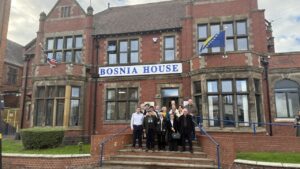
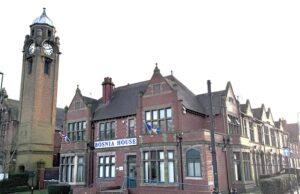
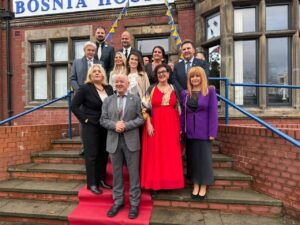
Many thanks to the ladies from the UK who participated in tonight’s program. They are: Mr. Oliver Kamn, writer and columnist for the famous magazine The Times, Dr. Waqar Azmi OBE, Rt Hon James Brokenshire MP and Lord Borune of Aberwyth who, among other things, attended the opening of the Bosnian House in November 2018. Also, many thanks for showing documentaries about building bridges of friendship, bridging differences and combating hatred.
A big thank you to all the volunteers, both known and unknown, for their selfless effort and time.
I am very glad that the guests from Bosnia and Herzegovina remembered in their addresses to the audience persons such as Mr. Paddy Ashdown, a British politician and former high representative of the international community in Bosnia and Herzegovina, who was known as the high representative who used the Bonn powers the most. Paddy passed away last year, and he was a great friend of our country.
They also paid tribute to Mr. Ed Vullamy, a British journalist and reporter for the Guardian and Observer, Ms. Penny Marshall and others who were among the group of journalists who in August 1992 revealed to the world the existence of the Prijedor death camps Omarska, Keraterm and Trnopolje.
Light at the end of the tunnel
Somewhere at the end of the tunnel there is a sun whose rays we must hold on to. We must believe in the future and optimism and learn from these ugly lessons from the past. We must not let oblivion win. We must be stronger, talk about the evil that happened to us, but at the same time try to build tolerance and respect with all people of good will. Young people like Amra, Vahida, Amina, the many volunteers from Remembering Srebrenica that I meet at commemorations promise this.
Fighting for a better place under the sun is our duty. It is our duty not to forget the victims. It is our duty not to forget our roots. To learn, to read, to study, that is what our faith tells us.
Promoting BiH in the best light not only through politics, but also through education, humanitarian organizations, literature, sports, music and everyday life is our duty. This is exactly what Aida Čorbadžić, an opera singer, and Elvir Solak, artists from the National Theater in Sarajevo, did through music. World-class, and ours. For everyone’s pride.
We have said a lot, and a lot more remains unfinished, untold. Each of us has our own war story, and Srebrenica will remain known to the world for its own.
SO THAT SREBRENICA NEVER HAPPENS AGAIN TO ANYONE!
A big thank you to all the volunteers, both known and unknown, for their selfless effort and time.
I am very glad that the guests from Bosnia and Herzegovina remembered in their addresses to the audience persons such as Mr. Paddy Ashdown, a British politician and former high representative of the international community in Bosnia and Herzegovina, who was known as the high representative who used the Bonn powers the most. Paddy passed away last year, and he was a great friend of our country.
They also paid tribute to Mr. Ed Vullamy, a British journalist and reporter for the Guardian and Observer, Ms. Penny Marshall and others who were among the group of journalists who in August 1992 revealed to the world the existence of the Prijedor death camps Omarska, Keraterm and Trnopolje.
Light at the end of the tunnel

Somewhere at the end of the tunnel there is a sun whose rays we must hold on to. We must believe in the future and optimism and learn from these ugly lessons from the past. We must not let oblivion win. We must be stronger, talk about the evil that happened to us, but at the same time try to build tolerance and respect with all people of good will. Young people like Amra, Vahida, Amina, the many volunteers from Remembering Srebrenica that I meet at commemorations promise this.
Fighting for a better place under the sun is our duty. It is our duty not to forget the victims. It is our duty not to forget our roots. To learn, to read, to study, that is what our faith tells us.
Promoting BiH in the best light not only through politics, but also through education, humanitarian organizations, literature, sports, music and everyday life is our duty. This is exactly what Aida Čorbadžić, an opera singer, and Elvir Solak, artists from the National Theater in Sarajevo, did through music. World-class, and ours. For everyone’s pride.
We have said a lot, and a lot more remains unfinished, untold. Each of us has our own war story, and Srebrenica will remain known to the world for its own.
SO THAT SREBRENICA NEVER HAPPENS AGAIN TO ANYONE!
Semira Jakupovic
Guildhall, July 10, 2019.