The agony of fleeing for bare life lasted four days, but for all those who managed to leave the Srebrenica hell alive, that journey seemed years long. Hiding and escaping through the forests, avoiding ambushes, shelling, poisons and traps set by the enemy. Along with hunger, wounding and death, all this represented suffering with no end in sight. At least not the happy one.
Until that day, July 16, 1995, four days after the group led by the then 20-year-old Mujo Delić fled from the bloodthirsty enemy who was leaving behind thousands of corpses in the “protected zone of Srebrenica”, a free territory did not appear.
Mujo witnessed scenes of unspeakable tragedy, horrific suffering, and scenes that haunt him to this day. He was badly wounded, but he survived. Many did not, including as many as 21 members of his family and countless friends.
“Many stayed by their wounded brother because they couldn’t leave him, but they couldn’t carry him either. Many fathers stayed by their dead son. I saw a father carrying his dead son, without a leg, and begging us to help him and bandage him, so dead… Those images still haunt me,” Mujo Delić told Al Jazeera.
A prisoner decorated by King Charles
In another story about the suffering of war in Bosnia and Herzegovina, former camp inmate from Omarska and Manjača, Sabit Jakubović, received an order from the British King Charles that entitled him to the title MBE (Member of the Order of the British Empire), which is awarded to people who have done something significant on a national level, for the benefit of British society. Jakubović earned this enormous honor by sharing his terrible story of the camp inmates with English children and adults, explaining to them what they, perhaps, did not know. Or knew wrongly.
As a friend of Bosnia and Herzegovina, Jakubović met Charles even before he was crowned king.
Jakubović is not from Srebrenica, but his ordeal is on a par with that of Srebrenica. He comes from a village near Omarska, near Prijedor. When Kozarac fell, he was taken to the infamous Omarska camp, where he spent 72 days. He was then transferred to Manjača.
Ironically, the fact that, with his height of 182 centimeters, he weighed only 44 kilograms is responsible for the fact that, with the mediation of Doctors Without Borders and the International Committee of the Red Cross, in agreement with the then RS authorities led by convicted war criminal Radovan Karadžić, he was evacuated as one of the 68 most serious cases in the camp.
He came to England from Bosnia and Herzegovina then, but Bosnia and Herzegovina did not leave him. Moreover, it speaks from him whenever the opportunity arises.
Decades have passed since what still haunts them today, but for Muja and Sabit, it’s as if they haven’t.
Delić exchanged his life in Voljevica near Bratunac, where he grew up, for a post-war life in Great Britain, but every July he returns to where he fled to pay tribute to the victims of the greatest bloodshed in Europe since World War II.
Attract as many English people as possible
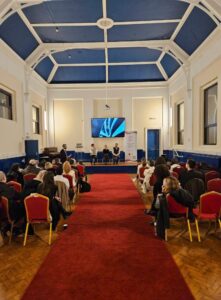
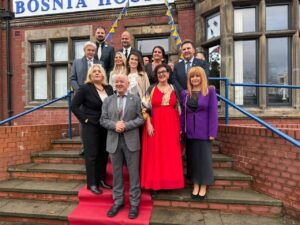
He will come now, but before that, on Saturday, June 29, in Guildford, a small town in the southwest neighborhood of London, he will lead a one-and-a-half-hour march in which Bosniaks who survived the hell of war in Bosnia and Herzegovina will participate.
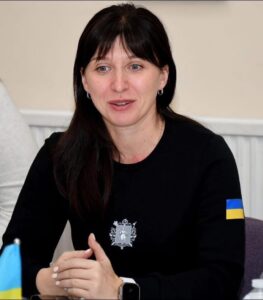
“Last year, my friends and I came up with the idea that we could honor all the martyrs of Bosnia and Herzegovina with a walk,” explains Delić.
“The response was very good, because in addition to 100 to 150 Bosnians and Herzegovinians, we also attracted a small number of English people. This year, the interest is greater, and that is our goal, to have as many of our people and as many English people as possible come to such gatherings. They know that there was a war in Bosnia and Herzegovina, but they do not know the first truth, which they can only learn through our stories, the stories of us survivors,” Delić tells Al Jazeera.
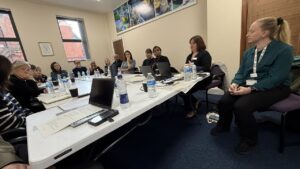
With authentic testimonies, everyone who will be there will convey their exodus to those present. Bosniaks who survived Srebrenica, Mostar, Sarajevo and Tuzla, children who were only 10 to 15 years old during the war, but who remember everything that happened, as well as those who survived the hell of the camp, will speak.
Jakubović, whose stay in England turned into a mission to spread the “truth about the war in Bosnia and Herzegovina”, will also speak.
“Last week I was in Coventry where I gave a speech to schoolchildren about my journey through the camps. I explained everything to them, where Bosnia and Herzegovina is, what was happening… I see that as my greatest mission, because the newer generations know little about it. Thank God Bosnia is no longer on television, they only know about Ukraine, Gaza… so this is an ideal opportunity for them to hear my story about suffering in Bosnia,” Jakubović tells Al Jazeera.
He participated in the march in England last year and sees great significance in it, especially given the current situation in his homeland, in the midst of genocide denial and attempts at its destruction.
Strong emotions
Jakubović claims that this causes new pain and anger among survivors.
“First, we are publicly spreading the truth, which is especially important in this period when the final phase of genocide is taking place – its denial. That a people can be genocidal is not true, but it cannot be true either that the ‘crime’, as deniers like to say, was committed by individuals. It is not true. They were, but according to the instructions, plans and orders of the institutions of RS and Serbia, so the thesis of individual responsibility should be rejected, as well as the responsibility of the entire people, which I recently emphasized in one of my speeches,” says Jakubović.
“The very fact that even today they find the remains of one person in multiple mass graves, primary, secondary or tertiary, is catastrophic. In addition, we have these ideas about peaceful separation or the Serbian world. All of this causes very severe emotional pain, anger and rage towards the ideology that is still alive in the RS and in Serbia. That is why these events are important, to tell the truth once again,” he added.
Saturday in Guildford will be tough, but Delić points out that events like this, no matter how horrible memories they evoke, are necessary.
“Emotions are very strong, especially in July, a month that is very difficult for us, but gatherings like this serve as therapy for us,” says Delić.
“There are many interested people who want to share their stories with us. They are all difficult stories, terrible stories, but stories that need to be heard. Those who were 10 or 15-year-old children then, but who still carry war traumas, will speak. Their stories must be heard, especially by the English. They bring them closer to the real situation and help them look at Bosnia and Herzegovina and us Bosnians who live here differently,” says Delić.